





In medical device injection molding production, flash (also known as burr or flying edge) is one of the most common and frustrating quality defects. Once flash appears on a product, it not only affects appearance but can also lead to poor assembly and bacterial growth. In severe cases, it directly impacts the safety and compliance of medical devices. When engineers encounter flash, their first reaction is often to wonder: is this caused by excessive mold clearance, or is it due to insufficient clamping force? This article will analyze and help you systematically resolve flash issues from these two core factors.
Flash refers to thin, excess plastic that appears on the parting line, slider mating surfaces, or ejector pin holes of injection molded products. In the general consumer goods sector, minor flash can sometimes be removed through post-processing. However, in the medical field, since products come into direct or indirect contact with the human body, any flash can become a breeding ground for bacteria or cause scratches during use. Therefore, the tolerance for flash in medical injection molding is virtually zero.
Mold clearance refers to the fit distance between the moving mold and the fixed mold in the closed state. The size of this clearance directly determines whether molten plastic will seep into the gap under high pressure.
When the mold clearance is too large, molten plastic is pushed by the injection pressure and holding pressure into the space between the parting surfaces, much like water seeping through a door crack. After cooling, this forms flash. This situation is especially common in the following scenarios:
First, after long-term use, the parting surface wears and the clearance increases. This is particularly true for stainless steel molds or cemented carbide molds commonly used in medical injection molding. Although they have good wear resistance, after hundreds of thousands of opening and closing cycles, microscopic wear still occurs on the parting surface.
Second, insufficient machining accuracy of the mold. If the parallelism and flatness of the parting surface did not meet requirements during the manufacturing stage, and the local clearance is too large, flash will repeatedly appear at the corresponding positions.
Third, uneven temperature distribution in the mold causes thermal deformation. High-temperature materials commonly used in medical injection molding, such as PEEK and PPSU, have strict mold temperature requirements. If the cooling water channel design is unreasonable and the mold expands locally due to heat, the clearance will change, resulting in flash.
There is a simple method to determine whether it is a mold clearance issue: observe the location and shape of the flash. If the flash appears at a fixed position on the parting line, and the thickness is uniform and continuous, it is most likely a mold clearance problem.
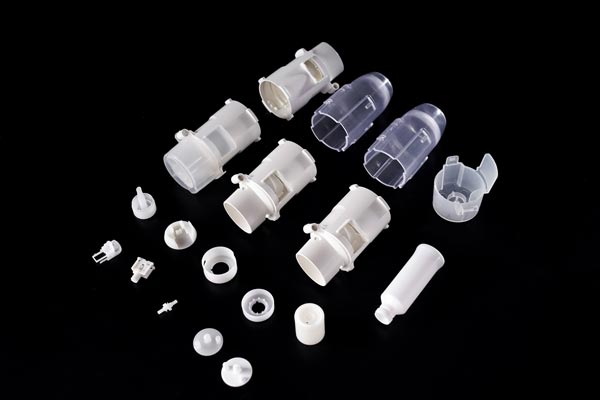
Clamping force is the clamping force applied by the injection molding machine to the mold in the closed state. Its function is to resist injection pressure and prevent the mold from being forced open.
When the clamping force is insufficient, even if the mold clearance is within a reasonable range, the high-pressure molten material can still slightly force the moving mold and fixed mold apart, creating a momentary gap. Plastic then seeps in and forms flash. The manifestations of this situation differ from those of a clearance problem:
First, the flash often does not appear at a fixed position but changes with injection parameter adjustments. For example, if flash worsens when injection pressure or holding pressure is increased, and improves or even disappears when they are reduced, this is a typical sign of insufficient clamping force.
Second, flash may appear in multiple directions of the product, not limited to the parting line. It may even appear at the mating positions of sliders and lifters, because these positions also require clamping force to maintain sealing.
Third, if the same mold is used on injection molding machines of different tonnages, and the smaller tonnage machine produces flash while the larger one does not, it can almost certainly be determined to be a clamping force issue.
In actual production, flash is rarely caused by a single factor. It is often the result of both factors combined. The following is a practical diagnostic process:
First, check whether the flash appears at a fixed position. If yes, prioritize checking the mold clearance. Measure the fit of the parting surface, and if necessary, perform mold lapping or weld repair.
Second, try adjusting the clamping force. Increase the existing clamping force by ten to fifteen percent and observe whether the flash improves. If there is a noticeable improvement, it indicates that the clamping force is indeed insufficient.
Third, check the injection process parameters. Excessive injection pressure, too long holding time, and too high melt temperature all aggravate flash. Appropriately reducing these parameters is sometimes more effective than repairing the mold or changing the machine.
Finally, conduct a comprehensive assessment. If increasing the clamping force eliminates the flash but it returns when reduced, it means the mold clearance is too large and needs to be addressed at the root. If increasing the clamping force significantly reduces the flash but a small amount still remains, it may be a dual issue of both clearance and clamping force, and both need to be addressed simultaneously.
Materials used in medical injection molding, such as PC, PPSU, PEEK, and ABS, have very different fluidity and shrinkage rates. High-fluidity materials like PC are more prone to flash and have higher requirements for mold clearance and clamping force. At the same time, medical products often have complex structures with many sliders and inserts. Every mating surface is a potential source of flash, which places higher demands on the overall precision of the mold and the clamping force reserve of the injection molding machine.
It is generally recommended that the clamping force for medical injection molded products should retain at least twenty percent safety margin, and the fit clearance of the mold parting surface should be controlled within 0.02 millimeters to fundamentally eliminate flash.
Returning to the original question: when flash appears on medical injection molded products, is it a mold clearance issue or a clamping force issue? The answer is: both are possible, and they often coexist. Mold clearance is a static structural cause, while clamping force is a dynamic process-related cause. Only through systematic troubleshooting, locating the problem first and then addressing it, can the issue be resolved efficiently to ensure the quality and compliance of medical products.
Q: Are flash and flying edge the same thing?
A: Yes. Flash, flying edge, and burr all refer to the same defect in the injection molding industry. They are just different regional terms. The essence is the same: excess plastic thin sheets at the parting line or mating surfaces.
Q: Can increasing clamping force completely solve the flash problem?
A: Not necessarily. If the mold clearance is already too large, simply increasing the clamping force can only alleviate the problem, not eliminate it. The most fundamental method is to repair the mold clearance while ensuring sufficient clamping force.
Q: Which material in medical injection molding is most prone to flash?
A: Materials with high fluidity are most prone to flash, such as PC (polycarbonate) and ABS. Although high-temperature materials like PEEK and PPSU have relatively lower fluidity, due to their high processing temperatures and high injection pressures, they have higher clamping force requirements and also need special attention.
Q: What should I do if flash still exists after mold lapping?
A: Lapping can only repair local wear on the parting surface. If the flash appears at sliders, lifters, or ejector pin holes, you need to check the fit clearance of these moving components. If necessary, replace the worn parts or re-machine the mating surfaces.
Q: If the injection molding machine tonnage is insufficient, do I have to change the machine?
A: Not necessarily. You can first reduce the required clamping force through process optimization, such as lowering injection pressure, shortening holding time, and reducing melt temperature. If it is still insufficient after optimization, then consider switching to a larger tonnage injection molding machine.
PREV:Why Do Medical Injection-Molded Parts Keep Failing? A Comprehensive Guide
NEXT:Black Spots on Injection Molded Products: Raw Material Contamination or Screw Issue?
Add: 62 Jinghai East Road, Chang'an Town, Dongguan City, Guangdong Province
Whatsapp: +86 13342659272
Email: Yuliya.chen@yizemould.com

Add: 62 Jinghai East Road, Chang'an Town, Dongguan City, Guangdong Province
Whatsapp: +86 13342659272
Email: Yuliya.chen@yizemould.com
 Home
Home