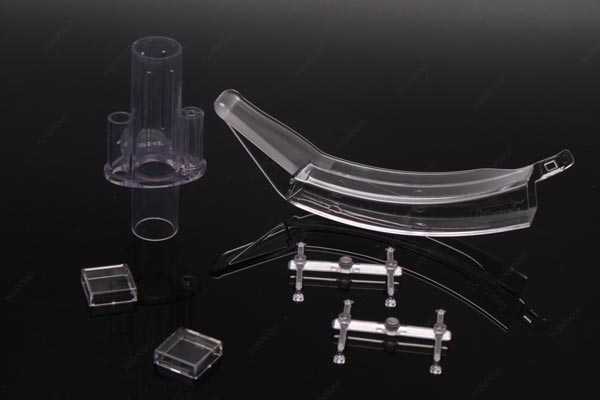
Laryngoscopes, as critical medical devices, require high-quality injection-molded parts to ensure safety and reliability. However, white marks on the surface—a common defect during laryngoscope injection molding—manifest as white streaks, foggy patterns, or localized protrusions at ejector pin positions, severely compromising both appearance and structural integrity. This article systematically explores effective strategies to address this issue from three perspectives: mold design optimization, injection molding process refinement, and material selection.
1. Mold Design Optimization: Minimizing White Marks at the Source
Mold design is pivotal in preventing white marks by reducing ejection resistance and distributing stress evenly.
-
Ejector Pin Layout and Sizing
Insufficient or improperly positioned ejector pins cause localized stress concentration. For instance, using a single thin ejector pin for thin ribs on a laryngoscope housing leads to high pressure and white marks. Solutions include:
-
Increasing contact area: Replace sharp ejector pins with flat-top pins or ejector blocks to disperse pressure. For example, use larger-diameter pins or stepped ejector structures to direct force to high-strength areas.
-
Strategic layout: Position ejector pins under thick walls, ribs, or bosses, avoiding uneven wall thickness. For example, add extra pins near snap-fit features on the housing.
-
Delayed ejection: For deep ribs or complex geometries, incorporate delayed ejection mechanisms (e.g., reverse ejector pins) to ensure staged release, reducing abrupt force application.
-
Draft Angles and Surface Finish
-
Increase draft angles: Thin-walled parts require ≥1.5°, thick-walled parts ≥3°, and transparent parts up to 5°. Insufficient draft angles cause part sticking, necessitating excessive ejection force.
-
Mirror polishing: Polish cavity and core surfaces to Ra ≤ 0.2μm, enabling "slip-out" ejection instead of "pull-out," which reduces stress.
-
Vacuum Release and Venting
-
Clean ejector pin holes: Remove plastic residue to ensure air intake during ejection, preventing vacuum-induced sticking.
-
Add vent slots: Incorporate vents at parting lines, ejector positions, and part ends to prevent trapped air from increasing ejection resistance.
2. Injection Molding Process Refinement: Precise Parameter Control to Reduce Internal Stress
Process parameters directly influence internal stress and ejection performance. Optimizing injection pressure, packing pressure, melt temperature, and mold temperature can significantly mitigate white marks.
-
Pressure and Speed Control
-
Lower injection and packing pressures: Excessive pressure increases residual stress, causing white marks upon ejection. Reduce injection pressure by 10–20% and packing pressure to 80–90% of material recommendations.
-
Multi-stage injection: Use low initial speed (30–50%) to avoid turbulence, then increase gradually (70–80%) for complete filling, and reduce to 20–30% for pressure maintenance.
-
Slow ejection speed: Reduce ejection speed to 50–70% of the original value and adopt multi-stage ejection (e.g., light initial push followed by full pressure).
-
Temperature Management
-
Raise melt temperature: Increasing temperature (e.g., PC from 280°C to 295°C) softens the material, reducing ejection resistance. Avoid overheating to prevent degradation.
-
Optimize mold temperature: Set thin-walled parts at 40–60°C and thick-walled parts at 80–100°C for uniform cooling. For example, thin edges of the housing at 50°C and thick bosses at 90°C.
-
Extend cooling time: Calculate cooling time using the formula (cooling time ≈ plastic thickness² × material coefficient; e.g., 45 seconds for 3mm ABS) to ensure full solidification before ejection.
-
Lubrication and Toughening
-
Add lubricants: Incorporate 0.5–1% silicone oil or stearic acid to reduce melt viscosity and ejection friction. For example, 0.8% silicone oil in PC improves demolding.
-
Select toughened materials: For stress-prone areas (e.g., glass-fiber-reinforced plastics), use toughened grades (e.g., PA66 toughened) to enhance impact resistance and reduce white marks.
3. Material Selection and Preprocessing: Enhancing Demolding Performance from the Root
Material properties directly affect ejection behavior. Choosing low-viscosity, high-toughness materials and controlling drying and recycled material usage can minimize white marks.
-
Low-viscosity materials
High-viscosity materials (e.g., PC, POM) struggle to fill molds, accumulating stress at ejector pins. Switch to more fluid materials (e.g., LCP) or adjust parameters (higher melt/mold temperatures) to improve flow. For example, LCP in thin housing sections reduces filling issues and white marks.
-
Strict drying control
Excess moisture causes hydrolysis, generating gases that increase internal stress. Dry materials thoroughly (e.g., PC at 120°C for 4–6 hours) to ≤0.02% moisture content.
-
Limit recycled material use
Recycled material (e.g., sprues) has degraded molecular chains, reducing strength and promoting white marks. Keep recycled content ≤20% and ensure batch consistency to avoid compatibility issues.
4. Case Study: Resolving White Marks on a Laryngoscope Housing
A medical device manufacturer faced white marks on snap-fit edges of laryngoscope housings. The following measures resolved the issue:
-
Mold modification: Enlarged ejector pins from 2mm to 4mm, added reverse pins for delayed ejection, increased draft angles from 1° to 3°, and polished surfaces to mirror finish.
-
Process optimization: Reduced injection pressure from 120MPa to 100MPa, packing pressure from 80MPa to 60MPa, and ejection speed from 100mm/s to 60mm/s with multi-stage ejection; raised melt temperature to 295°C and adjusted mold temperatures to 50°C (thin) and 90°C (thick).
-
Material adjustment: Switched to toughened PC with 0.8% silicone oil lubricant.
After implementation, white marks were eliminated, and yield rates improved from 85% to 98%, boosting production efficiency.
5. Summary: A Three-Step Approach to Systematically Solve White Marks
Addressing white marks in laryngoscope injection molding requires a systematic "mold-process-material" strategy:
-
Mold inspection: Verify draft angles, ejector pin layout, and surface finish.
-
Process adjustment: Optimize pressure, speed, and temperature parameters using multi-stage techniques.
-
Material selection: Choose low-viscosity, toughened materials and control drying and recycled material usage.
These strategies effectively eliminate white marks, enhancing product quality and manufacturing efficiency for medical devices.






 Home
Home